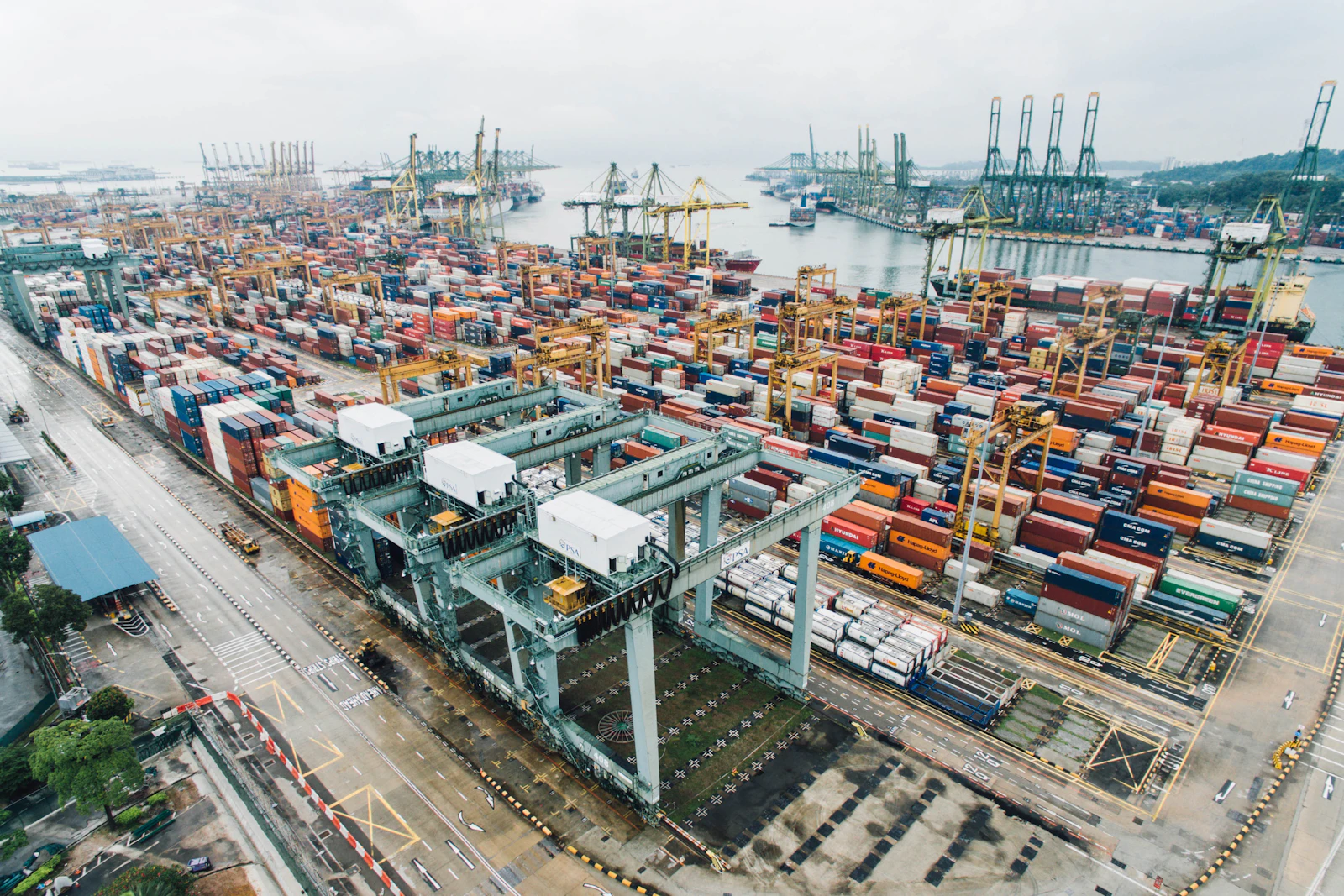
CBAM and India's CCTS – A Survival Strategy for Exporters

Introduction: CBAM Is Already Here
The Carbon Border Adjustment Mechanism (CBAM) is the European Union's carbon tariff on imports. It came into effect on January 1, 2026, placing a carbon price on emissions from highly traded, carbon-intensive products.
The impact on Indian exporters has been immediate and severe.
India's steel and aluminium exports to the European Union fell 24.4 percent in Financial Year (FY) 2025, with steel alone down 35.1 percent — before any CBAM financial obligation had taken effect. The decline, which suggests European buyers are already reorienting toward lower-emission producers, underscores what is at stake as India's Carbon Credit Trading Scheme (CCTS) enters its operational phase.
The levy of the carbon border tax in Europe is effective from 1st January 2026 for the sectors covered. According to GTRI, although the CBAM levy will technically be paid by EU importers, the financial burden will effectively be transferred to Indian suppliers through tougher price negotiations, stricter sourcing norms and reduced margins. To retain market access, exporters may be forced to accept price reductions in the range of 15–22%.
As one analysis notes, "Against this backdrop, India's Carbon Credit Trading Scheme (CCTS) is more than a climate policy; it is a survival strategy".
This guide provides a comprehensive analysis of CBAM, its impact on Indian exporters, how participation in India's CCTS can help protect export competitiveness, and what every exporter must do to prepare.
What Is CBAM and How Does It Work?
What Is CBAM?
The Carbon Border Adjustment Mechanism is a new carbon border tax notified by the European Union in May 2023. It is designed to:
- Prevent carbon leakage: Ensure that EU emissions reductions are not offset by increased emissions outside the EU
- Level the playing field: Protect EU industries from competition with producers in countries with weaker carbon regulations
- Incentivise global action: Encourage other countries to adopt carbon pricing
How It Works
| Step | Description |
|---|---|
| 1. Declaration | Importers must declare the embedded emissions of their imports |
| 2. Certificate Purchase | Importers purchase CBAM certificates to cover these emissions |
| 3. Deduction | If a carbon price has already been paid in the country of origin, it can be deducted |
| 4. Compliance | Importers must submit annual reports and compliance declarations |
Sectors Covered
CBAM currently covers six sectors:
- Iron and Steel
- Aluminium
- Cement
- Electricity
- Fertilizer
- Hydrogen
The CBAM Transition
| Phase | Period | Requirement |
|---|---|---|
| Transitional | October 2023 – December 2025 | Reporting only, no payment |
| Definitive | January 1, 2026 | Payment phase begins |
The CBAM Certificate
Starting from 2026, all EU trading partners will pay the same carbon price as EU manufacturers, with no distinction between advanced or OECD and emerging economies. The CBAM certificate expense (a form of carbon pricing) will likely be passed on to EU buyers through higher prices for imported products.
The Numbers: 24.4% Drop Before CBAM Even Bites
The Data
| Metric | Value |
|---|---|
| Steel and aluminium exports to EU (FY 2025) | Decline of 24.4% |
| Steel exports decline (FY 2025) | 35.1% |
| CBAM charge | €65–70 per tonne of CO₂ |
| Price reduction required | 15-22% |
| Indian steel exports to EU | ~2.2 million tonnes |
What These Numbers Mean
- 24.4% decline occurred before any CBAM financial obligation had taken effect
- European buyers are already reorienting toward lower-emission producers
- The financial impact of CBAM has not even begun to bite
- The decline will intensify as CBAM costs are fully applied
The CBAM Cost Share
IEEFA has examined how the CBAM cost will affect exports, with the analysis assuming that the CBAM certificate expense will likely be passed on to EU buyers. However, the competitive pressure will still fall on Indian exporters.
The Export Competitiveness Shock
From 2026, carbon intensity directly influences export costs, margins, and market access. Iron, steel, and aluminium account for the overwhelming share of India's CBAM-covered exports. High emissions intensity combined with deep integration into EU value chains makes CBAM a material industrial risk.
CBAM-Covered Sectors: Who Is Affected?
Iron and Steel
| Metric | Value |
|---|---|
| Exports to EU (FY 2025) | $7.4 billion |
| Decline in FY 2025 | 35.1% |
| CBAM estimated charge | €65–70 per tonne |
| Key Indian exporters | Tata Steel, JSW Steel, SAIL, ArcelorMittal Nippon Steel India |
Aluminium
| Metric | Value |
|---|---|
| Exports to EU (FY 2025) | $2.8 billion |
| Decline in FY 2025 | Part of 24.4% combined decline |
| CBAM estimated charge | €65–70 per tonne |
| Key Indian exporters | Hindalco, Vedanta, NALCO |
The CBAM Price Burden
A 2023 study showed significant impacts on steel and aluminium exports, with an estimated 25 per cent price burden on exports. This means exporters will likely have to absorb these costs to remain competitive.
The Production Route Factor
Production methods will play a decisive role in determining export viability:
| Production Route | CBAM Exposure |
|---|---|
| Blast Furnace–Basic Oxygen Furnace (BF-BOF) | Highest carbon costs |
| Gas-based Direct Reduced Iron (DRI) | Lower exposure |
| Scrap-based Electric Arc Furnace (EAF) | Lowest exposure |
| Aluminium (coal-based power) | Significantly increased CBAM burden |
How CCTS Can Shield Exporters from CBAM
The Mechanism
CBAM allows for the deduction of a carbon price already paid in the country of origin. CCTS compliance certificates can serve as evidence of this carbon price.
How CCTS Compliance Helps
| Aspect | How CCTS Helps |
|---|---|
| Carbon Price Evidence | CCTS certificates provide verifiable proof of carbon compliance |
| CBAM Deduction | CCTS compliance can be used to reduce CBAM liability |
| Credibility | CCTS is an official, government-backed scheme |
| Transparency | Verifiable, auditable carbon compliance data |
| Competitive Advantage | Demonstrates carbon leadership to buyers |
The IEEFA Perspective
According to IEEFA, a credible domestic carbon market can strengthen India's long-term industrial competitiveness, regardless of how discussions on the EU's Carbon Border Adjustment Mechanism (CBAM) evolve.
What matters now is how the EU's recognition of carbon prices paid in third countries will interact with India's market design, and how the CCTS can be calibrated so that domestic carbon costs are credited at the border. A stronger domestic carbon market supports industrial competitiveness and helps ensure that more of any carbon value is recognised and retained within India.
India's Strategic Response
India is considering a shrewd proposal: to apply its own carbon export levy, moving the point of revenue collection for CBAM-liable exports to the Indian border. The price point would need to match, and although this will be quite low when the CBAM comes into full operation in 2026, it will rise significantly towards 2030.
The MSME Challenge: The Data Gap
The Problem
A critical concern identified by GTRI is the lack of plant-level emissions data available to micro, small and medium enterprises (MSMEs) . Smaller exporters often depend on large domestic producers for raw materials, but do not receive verified emissions information required under CBAM rules.
The Default Values Risk
In such cases, EU authorities may apply default emissions values, typically set at conservative, high benchmarks, substantially inflating carbon costs even when actual emissions are lower.
The Impact on MSMEs
Industry representatives caution that this data gap could disproportionately affect MSMEs. Vinod Kumar, president of the SME Forum, said "CBAM risks becoming a trade barrier for smaller exporters, not due to product quality or competitiveness, but because of limited access to verified carbon data. Without greater transparency across supply chains, many MSMEs could be excluded from EU markets".
The Verification Requirement
From 2026, independent verification of emissions will be mandatory, with audits required to be conducted by EU-recognised or ISO 14065–compliant verifiers. The process is expected to be rigorous, akin to a financial audit, involving extensive documentation and validation.
The India-EU FTA and CBAM
The FTA Context
The CBAM warning comes against the backdrop of India advancing its negotiations with the EU, with expectations that the much-awaited full-fledged trade agreement could be signed in the next few months, possibly by the end of January or early February.
The CBAM Annexure
The India-EU FTA includes a dedicated CBAM annexure. Key provisions include:
- Dedicated framework to address CBAM concerns
- Comprehensive work plan
- Provisions to ease compliance for exporters, especially SMEs
Implementation Timeline
| Phase | Timeline |
|---|---|
| FTA Agreement | Expected early 2026 |
| CBAM Annexure Implementation | Likely 2027 |
What This Means for Exporters
- The FTA provides a framework for addressing CBAM concerns
- The CBAM annexure could ease compliance for exporters
- SMEs may receive special support provisions
Production Routes and Carbon Intensity
Steel Production Routes
| Production Route | CBAM Exposure | Explanation |
|---|---|---|
| Blast Furnace–Basic Oxygen Furnace (BF-BOF) | Highest | Relies on coal, highest emissions |
| Gas-based Direct Reduced Iron (DRI) | Lower | Uses natural gas, lower emissions |
| Scrap-based Electric Arc Furnace (EAF) | Lowest | Uses recycled scrap, lowest emissions |
Aluminium Production
| Production Route | CBAM Exposure | Explanation |
|---|---|---|
| Coal-based power | Highest | Coal-fired electricity increases carbon burden |
| Renewable-based power | Lower | Clean electricity reduces carbon burden |
The Competitive Dynamics
While large, low-emission producers may gain a competitive edge under the new regime, compliance costs and data challenges could push many smaller exporters out of European supply chains.
The Compliance Timeline: What Happens When
| Date | Event |
|---|---|
| October 2023 | CBAM transitional phase begins (reporting only) |
| January 1, 2026 | CBAM definitive phase begins (payment phase) |
| 2026 | First shipments subject to CBAM pricing |
| 2027 | Formal CBAM certificate surrender begins |
The First Shipments
From the first shipments of 2026, EU buyers registered as authorised CBAM declarants are expected to factor carbon intensity into supplier selection and contract terms. Carbon costs will be factored into every procurement decision, even though the formal surrender of CBAM certificates will begin only in 2027.
Contract Evolution
Contracts are also expected to evolve, with CBAM-related clauses becoming standard, covering cost pass-through mechanisms, verification obligations and renegotiation triggers linked to movements in EU carbon prices.
Strategic Recommendations for Exporters
Recommendation 1: Participate in the CCTS
| Action | Why It Matters |
|---|---|
| Register your entity | Start the CCTS compliance process |
| Understand your target | Know your emission intensity target |
| Develop a compliance strategy | Meet your target or procure CCCs |
| Document compliance | Maintain records for verification |
Recommendation 2: Reduce Emissions
| Action | Why It Matters |
|---|---|
| Invest in energy efficiency | Reduce emissions and costs |
| Adopt cleaner production routes | Move toward lower-carbon technologies |
| Use renewable energy | Reduce Scope 2 emissions |
| Process optimisation | Improve efficiency |
Recommendation 3: Prepare CBAM Data Packs
GTRI has urged exporters to develop internal CBAM pricing strategies, including adopting a "shadow carbon price" aligned with EU benchmarks. Exporters should also prepare standardised CBAM data packs for each manufacturing facility, detailing production routes, emissions intensity, verification status and audit contacts.
Recommendation 4: Address the MSME Data Gap
| Action | Why It Matters |
|---|---|
| Request verified emissions data | From large domestic producers |
| Conduct independent verification | Using ISO 14065–compliant verifiers |
| Maintain documentation | For CBAM declarations |
Recommendation 5: Seek Professional Advice
| Action | Why It Matters |
|---|---|
| Engage a carbon advisory firm | Get expert guidance |
| Develop a comprehensive strategy | Address all aspects of compliance |
| Stay informed | Monitor regulatory developments |
The IEEFA Perspective: Design Choices Matter
The Core Insight
A new IEEFA report maps the trajectory of the next phase of the CCTS, drawing on international experience to explore future design and sequencing choices. The analysis is structured around four interconnected themes:
- Financial market participation
- The design choices India faces in responding to border carbon costs (of which CBAM is the most prominent)
- Sectoral expansion (including the implications of incorporating the power sector)
- Managing offsets and Article 6 opportunities
The Lesson from Korea and PAT
In Korea, restricting early participation to compliance entities, alongside a surplus of allowances, left trading thin and prices subdued in the scheme's initial years. India's own Perform, Achieve and Trade (PAT) scheme saw certificate trading fall short of the volumes mandated. Both point to the same lesson: market depth and price signals depend first on whether targets create genuine compliance pressure, and then on whether that pressure is consistently maintained.
The Role of Financial Intermediaries
As Saurabh Trivedi, co-author of the IEEFA report, notes: "Every major Emissions Trading System (ETS) began with compliance entities only. The CCTS is right to do the same. Financial intermediaries matter eventually for what they make possible: continuous price discovery and the hedging that gives firms confidence to commit to large decarbonisation investments over long horizons".
The Window of Opportunity
Determining the CCTS's trajectory now is sequencing choices, and the window to shape them is open before path dependencies harden. Priority should go to foundational elements: credible stringency, robust MRV, and genuine enforcement.
How Carboned.in Can Help
At Carboned.in, we help Indian exporters navigate CBAM with clarity and confidence.
Our CBAM Readiness Services
| Service | What We Do |
|---|---|
| CBAM Exposure Assessment | Evaluate your exposure and risk |
| CCTS Compliance | Help you meet domestic compliance obligations |
| Credit Procurement | Buy CCCs to demonstrate carbon compliance |
| Legal Documentation | Draft contracts and compliance documents |
| Regulatory Advisory | Stay informed about CBAM and CCTS developments |
| CBAM Data Pack Preparation | Help you prepare standardised data packs |
| MSME Support | Address the data gap challenge |
Why Choose Carboned.in?
| Reason | Why It Matters |
|---|---|
| Legal Expertise | Led by Siddharth Gupta, Advocate, Calcutta High Court |
| Regulatory Knowledge | Deep understanding of CCTS, CBAM, and trade policy |
| Practical Experience | Real-world experience with compliance and trading |
| End-to-End Support | From assessment to compliance |
Your first consultation is completely free. No obligation. Just honest advice.
How Carboned.in can help
Our team covers every dimension of India's carbon market — pick the service that matches where you are.
Frequently Asked Questions
What is CBAM?+
The EU's Carbon Border Adjustment Mechanism — a carbon tariff on imports effective from January 1, 2026.
What sectors are covered by CBAM?+
Iron and steel, aluminium, cement, electricity, fertiliser, and hydrogen.
How has CBAM affected Indian exports?+
Steel and aluminium exports to the EU fell 24.4% in FY 2025, with steel down 35.1%, before any CBAM financial obligation had taken effect.
How can CCTS help with CBAM?+
CCTS compliance can be used to demonstrate carbon compliance and potentially reduce CBAM liability.
What is the CBAM charge?+
Approximately €65–70 per tonne of CO₂.
What price reduction may be required?+
Exporters may be forced to accept price reductions of 15–22% to retain market access.
What is the MSME data gap?+
Smaller exporters often lack verified emissions data from large producers, exposing them to high default emission values.
What is the India-EU FTA?+
A trade agreement under negotiation that includes a dedicated CBAM annexure.
How does production route affect CBAM exposure?+
BF-BOF steel has the highest exposure; EAF steel has the lowest. Coal-based aluminium has higher exposure than renewable-based aluminium.
What should exporters do now?+
Participate in CCTS, reduce emissions, prepare CBAM data packs, and seek professional advice.
What is a shadow carbon price?+
An internal carbon price aligned with EU benchmarks to guide business decisions.
How can Carboned.in help?+
We provide CBAM readiness assessment, CCTS compliance support, credit procurement, legal documentation, and regulatory advisory.
Siddharth Gupta is the founder of Carboned.in and specialist counsel for India's carbon compliance framework — advising obligated entities, project developers, and buyers on CCTS, CR-I registration, and credit transactions.